


Akkermansia Muciniphila - A Guide To Akkermansia Supplements
- Josh Boughton

- Oct 24, 2025
- 8 min read
Updated: Oct 29, 2025
Akkermansia is a bacteria that has been getting a lot of attention lately. When something becomes extremely popular very quickly, it always makes me a little nervous, because the advertising and marketing often get way ahead of the science and safety, which is why I’ve waited to write anything about it.

What is Akkermansia muciniphila?
Akkermansia is a genus of bacteria that lives in our gut, and it is an important part of our microbiome. It primarily lives in the large intestine, where it feeds on mucin, a compound that makes up a part of the gut mucosa (gut lining).
Akkermansia muciniphila benefits
There are numerous claims about the benefits of Akkermansia muciniphila, but many of these are influenced by several factors that we will discuss later in the article. What is often overlooked is that Akkermansia can easily become overpopulated, leading to significant health issues. It’s essential to have a balance of these bacteria —not too much, not too little —think of Goldilocks and the Three Bears. This is one bacteria that can easily be overdone. It’s really frustrating to see numerous companies and websites promoting it without providing the whole picture.
When properly used, Akkermansia benefits include:
Supporting a healthy gut microbiome.
Supporting a healthy gut lining.
Supporting healthy short-chain fatty acid production.
Supporting a healthy immune system.
Supporting healthy gut motility.
Akkermansia foods
Akkermansia loves variety. Eating a wide variety of nutrient-dense, polyphenol and fiber-rich whole foods is the best way to help it flourish. This will also benefit the rest of your gut microbiome and overall health.
In particular, these foods are very helpful:
Apples with the skin
Berries
Onions
Green Bananas
Red and purple grapes with the seeds
You can eat the seeds. I promise a grape plant won’t grow in your stomach.
Onions
Asparagus
Cacao
Not that dull, lifeless stuff. Matcha should be a vibrant, bright green color and come in small containers, not big tubs, directly from the farm.
Artichokes
Pomegranates
Cranberries
Leeks
Carrots
Wild-caught fatty fish like sardines and salmon.

Ultra-processed foods and alcohol are the biggest things to avoid, as these can reduce your levels, but in general, they should be avoided as much as possible anyway. Please don’t rely on ultra-processed foods that are enriched with fiber to feed your good bacteria; they are a poor substitute for whole foods.
What Causes Low Levels of Akkermansia?
Ultra-processed foods and alcohol are the biggest dietary causes of low levels of Akkermansia. Please don’t rely on ultra-processed foods that are enriched with fiber to feed your good bacteria; they are a poor substitute for whole foods. For example, they lack the polyphenols found in colorful fruits and vegetables.
Practicing good stress management is a great way to support healthy Akkermansia levels.
Akkermansia Risks
It’s time to talk about what most companies selling Akkermansia don’t tell you about: the risks. While Akkermansia has enormous potential, it must be used appropriately and in the correct form, just like any supplement or medication.
Excessive levels of Akkermansia can degrade mucin, an essential component of the intestinal barrier, whereas optimal levels can help support a healthy intestinal barrier. This over-colonization can potentially increase the risk of colitis and IBD (irritable bowel disease). In immunocompromised individuals, this can lead to increased colonization of pathogenic bacteria due to a weakened intestinal barrier, potentially worsening intestinal infections or increasing the risk of them. This is especially a risk for people with Salmonella infection or those who have been on many antibiotics. People with endocrine and gynecological disorders, like PCOS or endometriosis, will have an even higher risk of problems from excessive levels of Akkermansia. Those suffering from Parkinson's and MS also carry a higher risk of problems from too much Akkermansia. For a more in-depth look at the risks, check out this article.
However, since there are so many benefits to this bacteria, what can be done to allow everyone to get the benefits of this bacteria, without the risks? Thankfully, in addition to eating a wide variety of nutrient-dense, polyphenol and fiber-rich whole foods, there are other safe ways for everyone to enjoy the benefits.
Live Akkermansia versus Pasteurized Akkermansia
Akkermansia supplements primarily come in two forms: live and pasteurized.
Let’s talk about the live ones first. These are considered probiotics, similar to other live bacteria products. So they should be subject to the same quality control standards, such as product bacteria count (CFU, colony forming units), stability (how the potency holds up versus the expiration date), survivability (do they survive stomach acid and colonize the gut), as well as proper labeling. There are other important factors, but those are the big ones.
The CFU (colony-forming units) count indicates the number of bacteria in a probiotic that have the potential to colonize the intestines. It’s not the total number of bacteria that matters, but how many can form a colony in the gut.
To make their products appear to have higher levels of bacteria, many Akkermansia companies have adopted the use of AFU (Active Fluorescent Units) as a measurement. For live probiotics to provide benefits, they must be able to form colonies. AFU measures all bacteria, regardless of their ability to form colonies. That is why CFU is the accepted standard for measuring probiotics. AFU is a way for companies to pad the label by preying on the false belief that more bacteria is better. It’s best to avoid using live probiotic products that use AFU as their measure of bacterial count, because you don’t really know what you are getting.
There are several other issues associated with live Akkermansia supplements.
The first is oxygen. Akkermansia does not do well in an oxygen-rich environment. So each time the bottle is opened, if it is a powder or a non-hermetically sealed capsule, it can begin to degrade the bacteria.
It is very sensitive to a low pH environment. This means that it has a very poor ability to survive stomach acid. Companies need to provide a way to survive stomach acid. Often, this comes in the form of enteric coating, which typically contains unwanted additives, such as plastics, that are not disclosed on the label, despite the law requiring full disclosure of enteric coating ingredients.
It also has a very fragile cellular structure, which can cause it to break down during shipping and storage. It is just not a very hardy bacteria.
Live Akkermansia are prone to clumping (not the technical term) during formulation and storage. This means only a small number of cells will survive when they pass through the upper GI Tract to reach the intestinal lining for colonization. Even more importantly, if the bacteria do reach the target area, their clumped state can mask proteins such as Amuc_1100, which are vital for its interaction with intestinal cells. Sorry, I know that got a bit sciency —basically, it means they won’t work well.
If companies overcome all these problems, the next issue is the risk of overcolonization, which can lead to the problems discussed earlier in this blog.
If you haven’t guessed by now, we are not big fans of supplementing with live Akkermansia, as there are just too many issues with it.
The next type is pasteurized Akkermansenia. Pasteurizing the bacteria causes them to lose their reproductive ability. This means they cannot overcolonize the gut, eliminating the safety issues. Pasteurizing them also makes them much more stable and helps to keep their cellular structure intact while they travel through the digestive tract.
Pasteurized Akkermansia are not live probiotics; instead, they are postbiotics. Since they do not form colonies in the gut and are not classified as probiotics, they cannot be measured using the standard probiotic measurement, CFU. The correct measurement for them is TFU (Total Fluorescent Units). This is the measure of the total number of bacterial cells.
There have been a number of studies comparing live versus pasteurized Akkermansia, and in the properly done ones, the pasteurized version has been more effective.
How to take Akkermansia muciniphila
Pasteurized Akkermansia is best taken once per day with food.
It should be stored in a cool, dry place, away from direct sunlight.
As with other supplements, it’s a good idea to speak with your healthcare practitioner before starting it.
What should you look for in an Akkermansia muciniphila supplement?
Here are a few, not the complete list (as that would make this blog way too long), things to look for when choosing an Akkermansia supplement.
First, always choose pasteurized Akkermansia to avoid the safety issues that live Akkermansia can cause.
Second, choose those that are strain labeled, specifically those with a strain that has undergone clinical trials, ensuring you get a proven product with benefits. It should not just say "Akkermansia" or "Akkermansia muciniphila"; it should also include the third part of the name.
It should use the exact dosage used in those clinical trials. For example, if a product uses a strain that was tested at 30 billion tfu in clinical trials, then a daily serving should contain 30 billion tfu. If the product contains only 5, 10, or 15 billion tfu, it will not provide the benefits shown at 30 billion tfu.
The product should be tested using the correct methods to ensure it contains the claimed TFU amounts on the label.
A significant issue with Akkermansia supplements, due to their rapid rise in popularity, is the proliferation of fake products on websites like Amazon. These counterfeit supplements not only fail to contain Akkermansia but also contain far fewer bacteria than stated on the label, among other problems. Most of these are coming from China and are labeled as being made in the USA. You will start to see reports of this coming out soon.
Triquetra AK-Postbio: Akkermansia Postbiotic
Researching this blog took quite a while, and we wrote most of it before we actually found a product that met the standards we had set. We sought a strain of pasteurized Akkermansia with clinical trials in humans demonstrating both safety and benefits. After a long search, we found strain Akkermansia munciniphila MUCT AA 835. This strain is the only form approved for use as a dietary supplement and certified safe by the European Food Safety Authority (EFSA). This strain is produced in Europe.
In 2004, the team of Professor Willem M. de Vos at Wageningen University discovered and patented the application of this novel bacterium and its growth conditions for human use.
Dr. Derrien, a PhD student under de Vos’ guidance, successfully isolated and characterized the bacteria. It was the same team that named the strain in honor of Dr. Anton Akkermans.
The special process by which this strain is produced increases the accessibility of the Amuc-1100 protein found in the bacteria, which helps to support the mucus lining. Rather than risking the breakdown of important mucin in the mucus lining, which can occur with live Akkermansia, this particular strain of pasteurized Akkermansia helps support it.
After finding the pasteurized strain we wanted, we sought a product made with that strain that contained 30 billion TFU, the dosage used in clinical trials that demonstrated benefits.
That search led us to this:
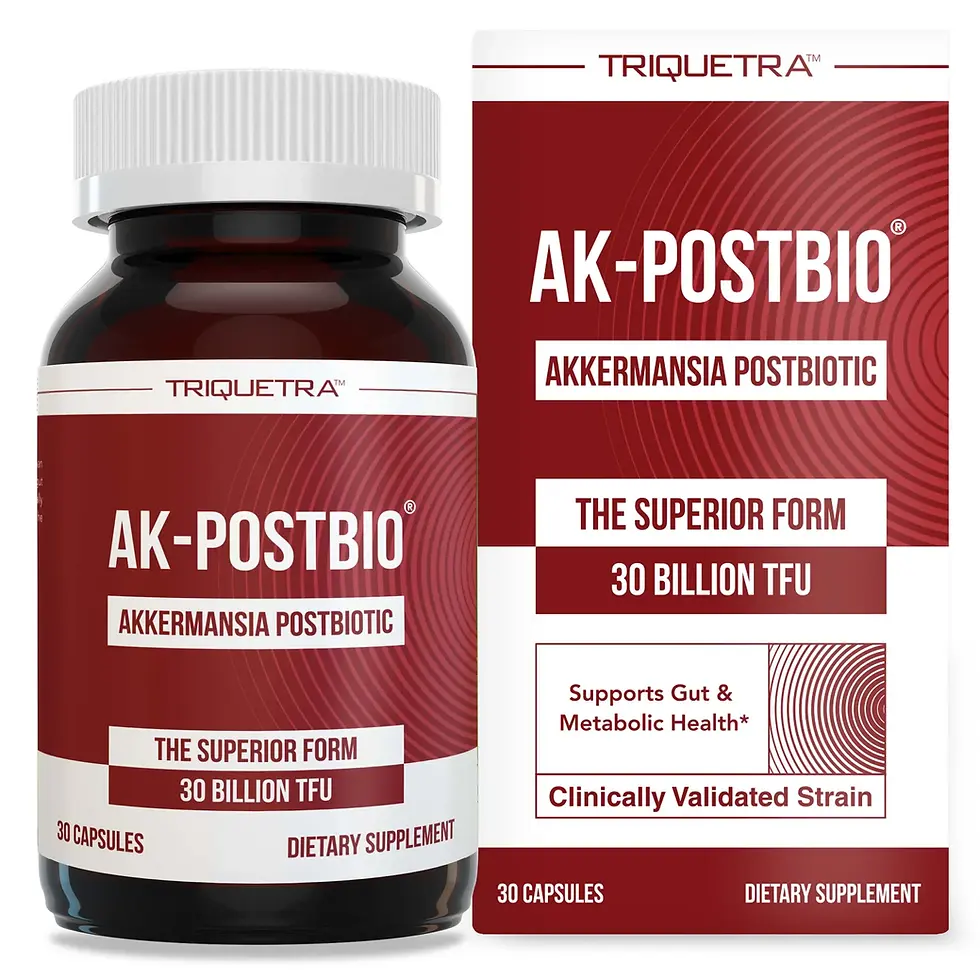
It checks all the boxes of what we were looking for in an Akkermansia supplement.
It is tested for contaminants like heavy metals, and it contains the potency that is claimed on the label. After production is complete, the finished bottles are then placed in a 2nd quarantine for 10 to 14 days. During this time, random bottles are pulled from production and sent to a 3rd-party laboratory for final product testing. The products must pass all testing to be released from quarantine.
So if you want to support healthy Akkermansia levels, here’s the plan:
Lots of polyphenol and fiber-rich foods.
Lots of wild-caught fatty fish
Take clinically researched, pasteurized Akkermanisa capsules containing the exact dosage and strain used in the research.
Akkermansia questions and support
If you have questions about Akkermansia bacteria, please email us at info@rooted-nutrition.com, and we'll be happy to answer them!


